 Authenticity Guaranteed — 100% Original Fragrances
 Free 5ml Tester with Every Order
 Cash on Delivery Available
 Pay with Tabby — Split in 4, Interest Free
 Pay with Tamara — Buy Now, Pay Later
 Luxury Fragrances Starting from AED 99
 Enjoy Free Delivery Anywhere in the UAE
 Exclusive Arabic Oud & Oriental Blends
 Gift Wrapping Available on All Orders
 New Launches Every Month — Stay Tuned
 Loved by 10,000+ Customers Across the UAE
 Same Day Dispatch on Orders Before 3PM
 Easy 7-Days Returns — Shop with Confidence


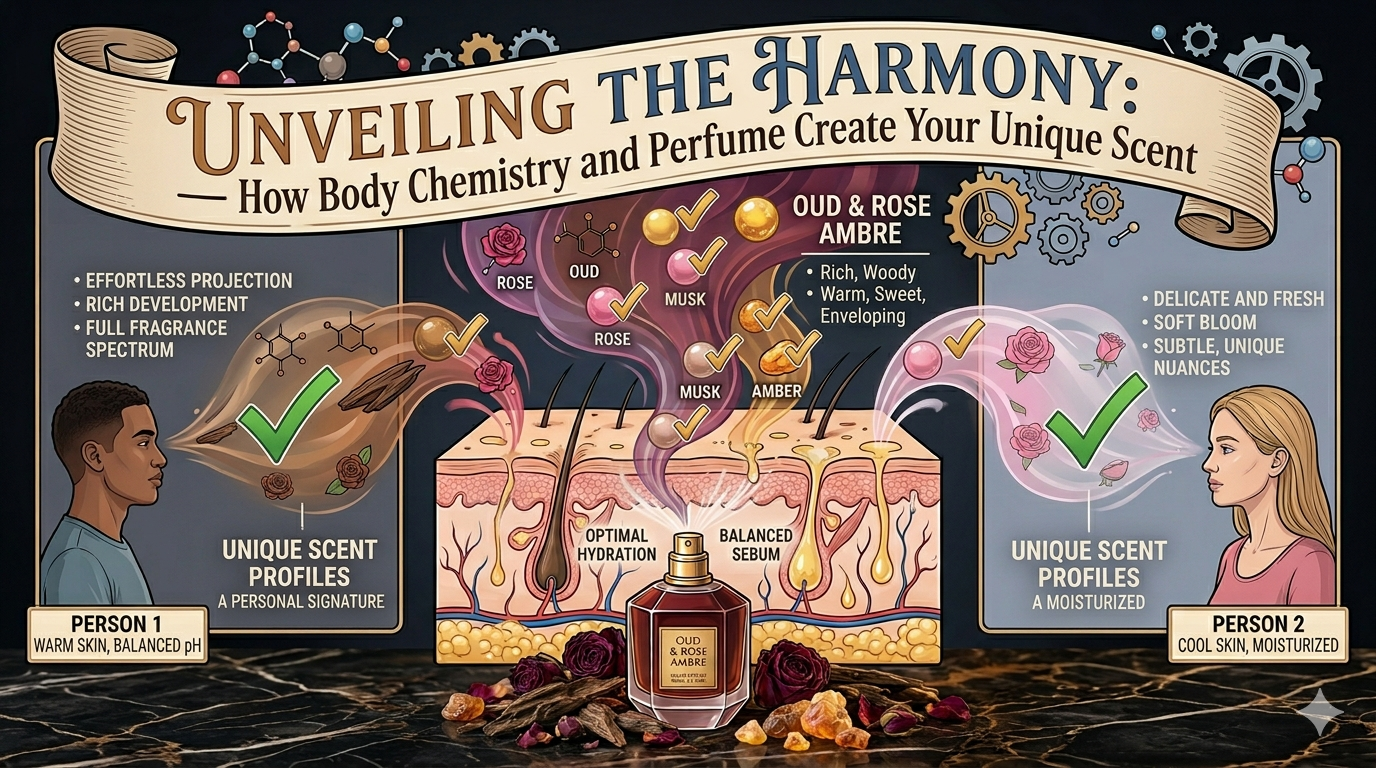
Two friends buy the exact same bottle. Same brand, same scent, same morning. They spray it on together, walk out the door, go about their day like normal. A few hours later they're sitting next to each other and one of them smells warm and woody while the other's gone soft and sweet. Neither one did anything different. Same amount, same spots on the skin, same time of day. And still they don't smell alike at all.
That's not some weird coincidence. It's just what happens when perfume meets skin chemistry, and honestly, it happens to almost everyone. Skin isn't like fabric, holding a scent flat and unchanged. It messes with it. Changes it. Once you actually notice that happening, you start thinking about fragrance completely differently.
What's Really Going On With Your Skin
Most people picture skin as basically a surface, something a perfume just sits on top of like a coat of paint. That's not really accurate though. The moment fragrance touches skin, it starts reacting natural oils, body heat, the bacteria that live there, hormones doing whatever they're doing in that particular moment. All at once. All of it quietly deciding how that perfume is going to smell on you specifically, not on anyone else.
Skin makes an oil called sebum, and it acts almost like glue for scent molecules grabbing onto them, letting them go slowly over hours instead of all at once. Oilier skin holds tighter, so you usually end up with something richer, something that sticks around longer. Drier skin doesn't have as much to grab onto, which is a big part of why perfume seems to disappear faster on some people than others.
Then there's the microbiome billions of tiny organisms living on your skin right now, totally normal, nothing to worry about. They break fragrance molecules down in ways that are, genuinely, unique to you. Nobody else has your exact microbial setup. So nobody wears a perfume quite the way you do.
How a Fragrance Actually Unfolds on Skin
A perfume was never really just one smell. It's built in layers three, usually and each one behaves differently once it hits skin.
Top notes show up first. Citrus, herbs, maybe a bit of pepper. They arrive fast and leave just as fast, usually gone in fifteen to thirty minutes. Then heart notes take over florals, spices, soft resins, whatever actually gives the fragrance its personality and these stick around for a couple of hours. After that come base notes: oud, musk, sandalwood, amber, vetiver. Heavier stuff that actually bonds to skin and can hang on for six, sometimes twelve hours.
Which of these stages lasts longest on you, which one fades too fast, which one blends into your own skin that's biology, mostly. Two people wearing the exact same bottle are, in a real sense, wearing two different perfumes without either of them doing anything wrong.
Skin pH Matters More Than Most People Realize
Here's something barely anyone thinks about pH. Healthy skin sits somewhere around 4.5 to 5.5 usually, a little acidic, though this shifts person to person and even moves around across your own body.
Fragrance reacts to whatever surface it lands on. More acidic skin tends to pull out brighter citrus and floral notes. Skin that leans alkaline slows those notes down, makes them feel warmer, sometimes powdery. Same exact bottle, two very different results. Neither one's wrong it's just chemistry doing what chemistry does.
Diet has more to do with this than people assume. Eating a lot of protein tends to push skin more acidic. Plant-based eating tends to keep things closer to neutral. Certain medications shift it too, and skin drifts more alkaline naturally as we get older which might explain why a scent you loved five years back doesn't quite land the same anymore.
Why Pulse Points Aren't Just a Myth
Heat is really the engine behind most of this. Warm skin pushes fragrance molecules off the surface faster, sends them further out into the air. That's the whole reason pulse points work in the first place wrists, neck, the inside of the elbow, behind the knees. Blood runs close to the surface at these spots, keeping them warmer than everywhere else, constantly reactivating the scent all day long.
It's also why perfume seems stronger in summer. Body runs warmer, air's warmer, humidity carries scent further than it normally would. The perfume itself hasn't changed one bit just the conditions around it. Run naturally warm, and you'll probably project scent further and longer than someone who runs cooler. Ever notice a fragrance lasting way longer on a friend than it does on you? Body heat's usually most of the answer right there.
Diet, Hormones, and What Your Skin Is Telling You
Skin's basically a mirror for whatever's happening inside your body, and all of it ends up shaping how fragrance behaves once it lands on you.
Garlic, red meat, cumin, alcohol this stuff gets processed internally and partly comes back out through sweat, sitting right there next to whatever perfume you've sprayed on. People eating a lot of red meat often notice smoky, woody perfumes coming through stronger. People eating mostly plants usually have a cleaner, more neutral base, so lighter scents show up clearer.
Hormones matter just as much, arguably more. Estrogen, testosterone, cortisol all of them shift what's in your sweat and natural oils. A lot of people notice their perfume smelling slightly different depending where they're at in their cycle sweeter some weeks, sharper others. Pregnancy can flip a favorite scent completely, for reasons nobody can fully explain. Menopause shifts things again later on. None of this is strange. It's just the body doing its thing, dragging your perfume along for the ride.
Skincare plays a quiet role in all this too. Unscented moisturizer helps fragrance last, since it gives scent molecules something hydrated to hold onto. Scented lotion underneath just gets in the way, competing with whatever you're actually trying to wear.
Choosing a Shuoor Perfume Based on Your Skin
Once you've got a sense of your own skin, picking something gets a lot easier.
For warm or oily skin, the Royal Vintage line is worth checking out. Emperor's Choice opens citrus, moves through lavender and spice, settles into deep wood and artemisia a base that keeps building for hours on warm skin. Crowned Glory opens with osmanthus, apricot, and fig, moves through cedar and orris root, lands on sandalwood, vanilla, caramel warmer skin pulls out more caramel, cooler skin hangs onto the fruit a bit longer. Knights Velour goes bergamot and pink pepper into neroli and nutmeg before settling on vetiver and moss reads green and earthy on cool skin, smoky and warm on skin running hot.
If your skin burns through scent fast, Divine Destiny from the Valkyries line is built for exactly that oud, leather, amber base that keeps pace with body heat constantly pushing it back out.
For dry or sensitive skin, the Brave Heart Siraj collection Rose Gold, Gold, Silver gives you florals that hold up fine without needing much sebum to work with. Moisturize first, hit the pulse points, let it develop on its own time.
Find the Shuoor scent made for your skin, not just your taste.
FAQs
Why does the same perfume smell different from person to person?
Skin's not a blank canvas. Oil levels, pH, warmth, even the bacteria living on your skin all of it reacts with fragrance differently, which is why the same bottle turns out completely different depending on who's wearing it.
Does dry skin make perfume fade quicker?
Usually, yeah. Without enough natural oil to grab onto the scent, fragrance evaporates fast and the deeper notes often don't get the chance to properly show up.
Does what I eat really affect how my perfume smells?
To some degree, yes. Diet shifts skin pH and changes what comes out through sweat, and both of those mix with whatever fragrance is already sitting on your skin.
Why do pulse points matter so much?
Blood runs close to the surface there, keeping those spots warmer than the rest of your skin. That steady warmth keeps reactivating the scent all day, helping it last longer and travel further.
What can I do to make perfume last longer on dry skin?
Put on an unscented moisturizer before you spray. It gives the fragrance something hydrated to hold onto instead of just evaporating off dry skin in minutes.


