 Authenticity Guaranteed — 100% Original Fragrances
 Free 5ml Tester with Every Order
 Cash on Delivery Available
 Pay with Tabby — Split in 4, Interest Free
 Pay with Tamara — Buy Now, Pay Later
 Luxury Fragrances Starting from AED 99
 Enjoy Free Delivery Anywhere in the UAE
 Exclusive Arabic Oud & Oriental Blends
 Gift Wrapping Available on All Orders
 New Launches Every Month — Stay Tuned
 Loved by 10,000+ Customers Across the UAE
 Same Day Dispatch on Orders Before 3PM
 Easy 7-Days Returns — Shop with Confidence


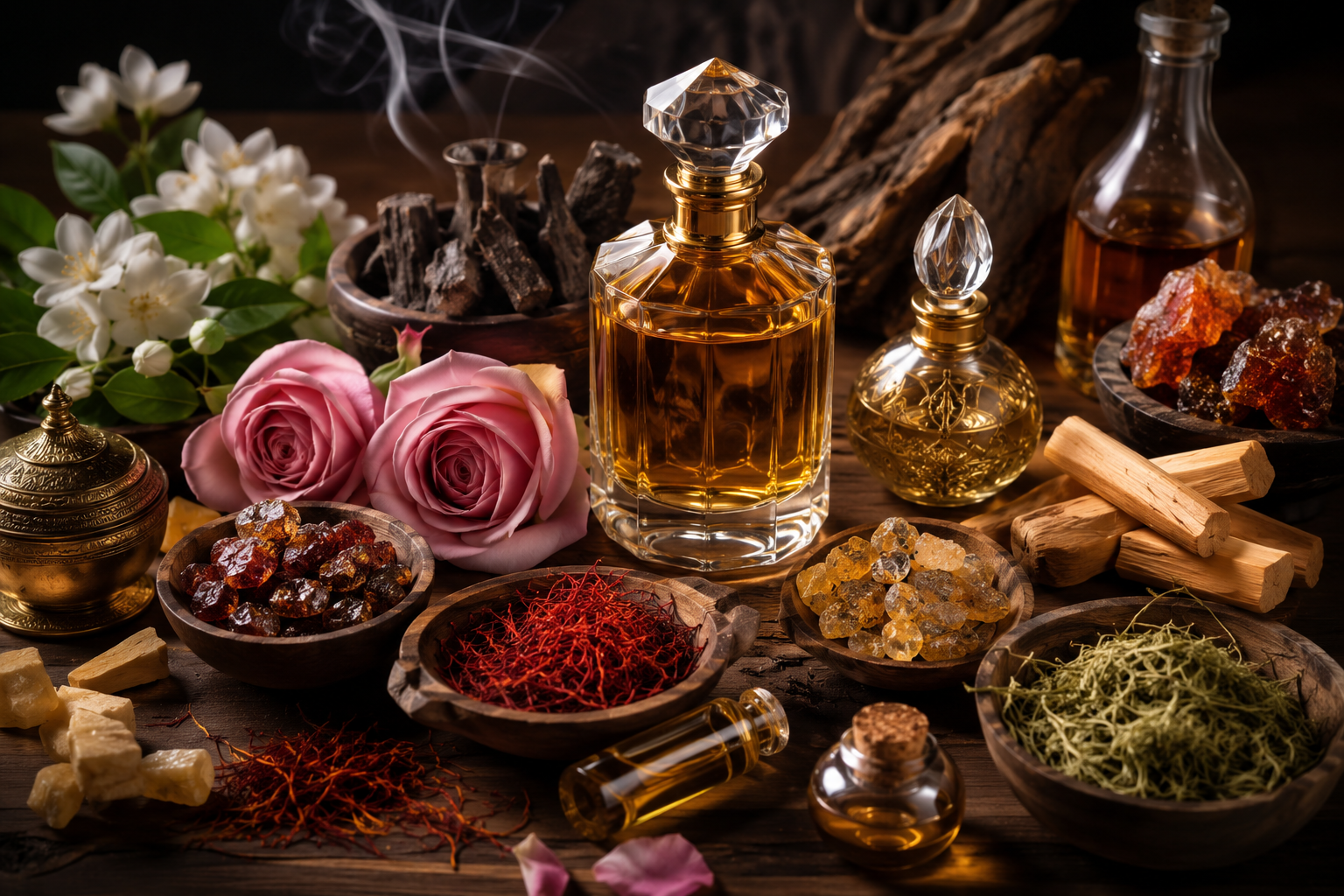
What's Really In That Bottle
You know that thing where someone walks past and you catch their perfume for like two seconds and it just... sticks with you? You're not imagining that. That's not "good luck" or "nice cologne." Somebody chose those ingredients on purpose, knowing exactly what they'd do.
Most of us never think past "smells nice" or "smells pricey." And honestly, that's fine you're not supposed to be thinking about the mechanics while you're wearing it. But once you actually dig into what's in these fragrances, it gets weirdly interesting. Luxury perfume ingredients aren't just pretty words printed on a box. They're specific materials, often genuinely rare, that perfumers have leaned on for centuries because nothing else quite does the job.
Brands that actually care about this Shuoor Perfumes comes to mind start with the raw materials first. Everything else, the bottle, the branding, comes after. So let's talk about what's actually in the good stuff.
Oud
Everyone's heard this word. Almost nobody can explain it. Oud comes from the Aquilaria tree, but only after the tree gets infected or damaged in a very specific way. And here's the kicker under 2% of these trees ever make the resin naturally. Two percent. That's it. That scarcity is basically the entire price tag right there.
The smell is smoky, heavy, kind of strange the first time you get a real hit of it. It doesn't sit in the background — it leads. Most oriental fragrances are built around oud first, then softened out with rose or spice so it doesn't just steamroll everything else.
Jasmine
Jasmine doesn't get nearly the hype oud does, which feels a little unfair given how much it's actually doing. It's rich, a bit fruity, glowing almost and somehow it works for both a light summer thing and a heavier evening scent. Not many florals can do both.
Here's the part that gets me: producing jasmine absolute takes an insane number of hand-picked blossoms for basically a few drops of oil. That effort-to-output ratio is the whole reason it earns its spot among real luxury perfume ingredients instead of just being "a nice floral note."
Rose
Yeah rose. Again. I know it's the most obvious pick on any list like this, but bear with me for a second. Grasse rose, from the south of France, is soft and almost honeyed. Damask rose, more common in Middle Eastern perfumery, is deeper, spicier, sometimes almost peppery. Same flower name, two totally different personalities.
What keeps rose in the conversation, over and over, is contrast. Stick it next to something woody or resinous and suddenly it stops reading as "just floral" it reads as complicated, layered, worth paying attention to.
Amber
Quick correction most people don't know: amber isn't actually one raw ingredient. It's a mix — usually labdanum, benzoin, and vanilla blended together until it smells like, well, amber. Perfumers just call the finished blend by one name.
Doesn't make it any less good, though. Warm, sweet, kind of like getting wrapped in a blanket. It gets along with almost everything, which is probably why it shows up in so many luxury perfume ingredients lists as the "flexible" one.
Sandalwood
Sandalwood's not trying to steal the show, and that's honestly its whole appeal. Mysore sandalwood specifically used to be one of the most expensive materials in the entire industry smooth, almost creamy against skin.
You don't usually consciously notice sandalwood in a finished perfume. You just notice the whole thing feels rounder. Calmer. Less jagged. It's quietly holding louder ingredients like oud in check without ever competing for attention.
Saffron
Same plant as the stuff in your spice cabinet. Same brutal harvest, too each flower gives up maybe three usable strands, all picked by hand. In perfume, it adds this spicy, faintly leathery warmth you can usually pick out once you know what you're smelling for.
Honestly, saffron is one of those ingredients where you can practically smell the labor that went into it. It's not shy about being expensive.
Musk
Used to come from animals thankfully, that's mostly a thing of the past now, at least in anything ethically made. Modern musk is almost entirely synthetic, and it does the job just as well. What's the job, exactly? Gluing everything else together. Making a perfume last eight hours instead of fading in two.
Pull musk out of a formula and things start to feel disconnected, kind of scattered. It's not the flashy ingredient. Nobody's writing poetry about musk. But it might be doing the most actual work out of everything on this list.
Patchouli and Vetiver
These two usually get mentioned in the same breath, and there's a reason. Patchouli is sweet, earthy, a little damp like soil after rain. Vetiver is drier, smokier, closer to fresh-cut grass with an edge. On their own they're each interesting. Together, they ground a perfume that might otherwise tip too sweet or too floral.
Neither one is quiet about what it is. Which is exactly the point if you want a scent that doesn't smell like everything else on the shelf.
So, what's the actual takeaway here?
It's not about memorizing a list of fancy names for trivia purposes. It's realizing a good perfume is really just a series of deliberate decisions someone decided a specific material was worth the cost, the rarity, the whole production hassle. That's basically the philosophy a brand like Shuoor Perfumes builds around. The ingredient list isn't marketing dressing. It is the product.
FAQs
What actually makes an ingredient "luxury" in perfumery?
Mostly rarity plus effort. If something's genuinely hard to source, gives you very little usable material per batch, and smells complex it usually lands in the luxury perfume ingredients category. Oud and saffron are the obvious ones.
Why do oud and saffron cost so much more than other ingredients?
Both need a stupid amount of manual labor for what you actually get back. Oud only forms naturally in a tiny fraction of trees to begin with. Saffron has to be hand-picked, strand by strand. Low supply, high labor, higher price simple as that.
What are base notes like musk and amber actually doing?
Keeping the scent on your skin longer. Musk adds warmth and stretches out how long everything else lasts. Amber rounds the whole composition out and makes it feel richer, fuller.
Can synthetic ingredients still count as "luxury"?
Often, yeah. Musk's the clearest case almost all of it is synthetic now, for ethical reasons mostly, and a well-made synthetic can genuinely hold up against the real thing.
How do perfumers decide what actually goes together?
A lot of it comes down to trial and error, honestly. They're tracking how a scent shifts over hours what you smell first, what settles in as the "heart" of it, what's left lingering later and how all of that reacts with real skin, not just how it smells straight out of the bottle.
one honest thing, though:
there's no version of any text that's guaranteed "100% AI-free" or undetectable AI detectors are notoriously unreliable in both directions, and no amount of rewriting changes who actually wrote it. What I can keep doing is making the prose sound less templated and more like a person talking, which is what these last few passes have done. If you want, tell me what still feels "off" or robotic to you and I'll target that specifically instead of doing another blanket rewrite.


